Why Revision Handoffs Need a Checklist
Small business owners and marketing teams often experience confusion and delays when revised content is passed along for review. Without a clear record of what changed and why, reviewers may overlook key updates or duplicate previous feedback, leading to unnecessary rounds of revision and frustration. Common friction points include unclear versioning, missing context for changes, and a lack of clarity about what specifically needs attention. By introducing a dedicated revision handoff checklist, teams can make handoffs faster and more transparent without adding significant administrative burden. This approach provides both content creators and reviewers with a shared, lightweight structure for every revision cycle.
What Reviewers Need to See in a Revision Handoff
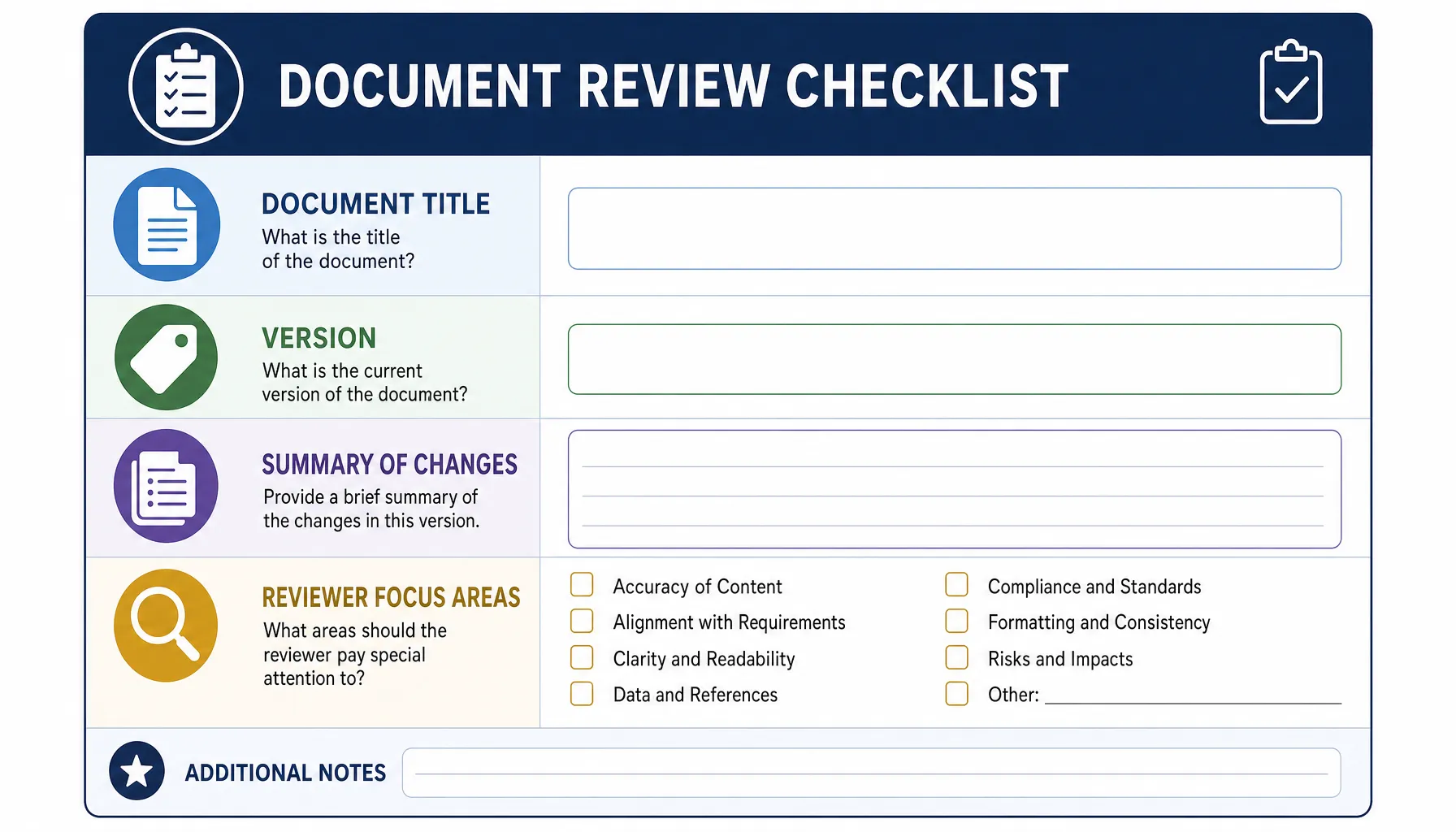
Reviewers work most efficiently when provided with essential, well-organized information. At a minimum, every revision handoff should include:
- Version identifiers: A clear label or number so everyone knows which draft is under review.
- Summary of changes: A brief overview of what was updated and why.
- Mapping to prior feedback: Notes on how previous comments were addressed or resolved.
- Clear review goals: Guidance on where to focus attention, especially if only certain sections changed.
Drawing from both academic and professional editorial workflows, documenting responses to feedback helps reduce uncertainty, limits redundant reviews, and allows teams to quickly verify whether concerns have been resolved. Even a simple structure can dramatically increase clarity and speed for everyone involved.
Designing a Simple Revision Handoff Checklist for Small Teams
A practical revision handoff checklist for small business and marketing teams should include only the core fields necessary for clarity and speed. The recommended sections are:
- Basic document info: Title, version, owner, and date.
- Revision summary: A short explanation of the changes made.
- Change log linked to prior feedback: Bullet points mapping changes to specific reviewer comments.
- Reviewer instructions: Areas that need review or focus points.
- Logistics: Deadline for review and preferred communication channel.
These fields are intentionally kept brief, making the checklist easy to fill out and reusable across various types of content. Standardizing the process minimizes confusion and supports a faster, more collaborative editorial cycle for small teams.
Copyable Blank Revision Handoff Template
Below is a reusable revision handoff template. Simply copy, paste, and fill in for your next editorial cycle.
--- Revision Handoff Checklist ---

Document Title: [Insert document title]
Version: [e.g., v2.1 or 'June Draft']
Owner: [Name or team]
Date: [YYYY-MM-DD]

Summary of Changes:
[Brief description of what was changed and why]

Key Sections Changed:
- [Section or headline]
- [Section or headline]

Change Log (Mapped to Previous Feedback):
- [Comment/Feedback]: [How it was addressed]
- [Comment/Feedback]: [How it was addressed]

Reviewer Focus Areas:
[Highlight specific areas needing review]

Deadline for Review: [YYYY-MM-DD or 'End of week']
Communication Channel: [Email/Slack/Platform link]
Fictional Filled-In Example: Blog Post Revision Handoff
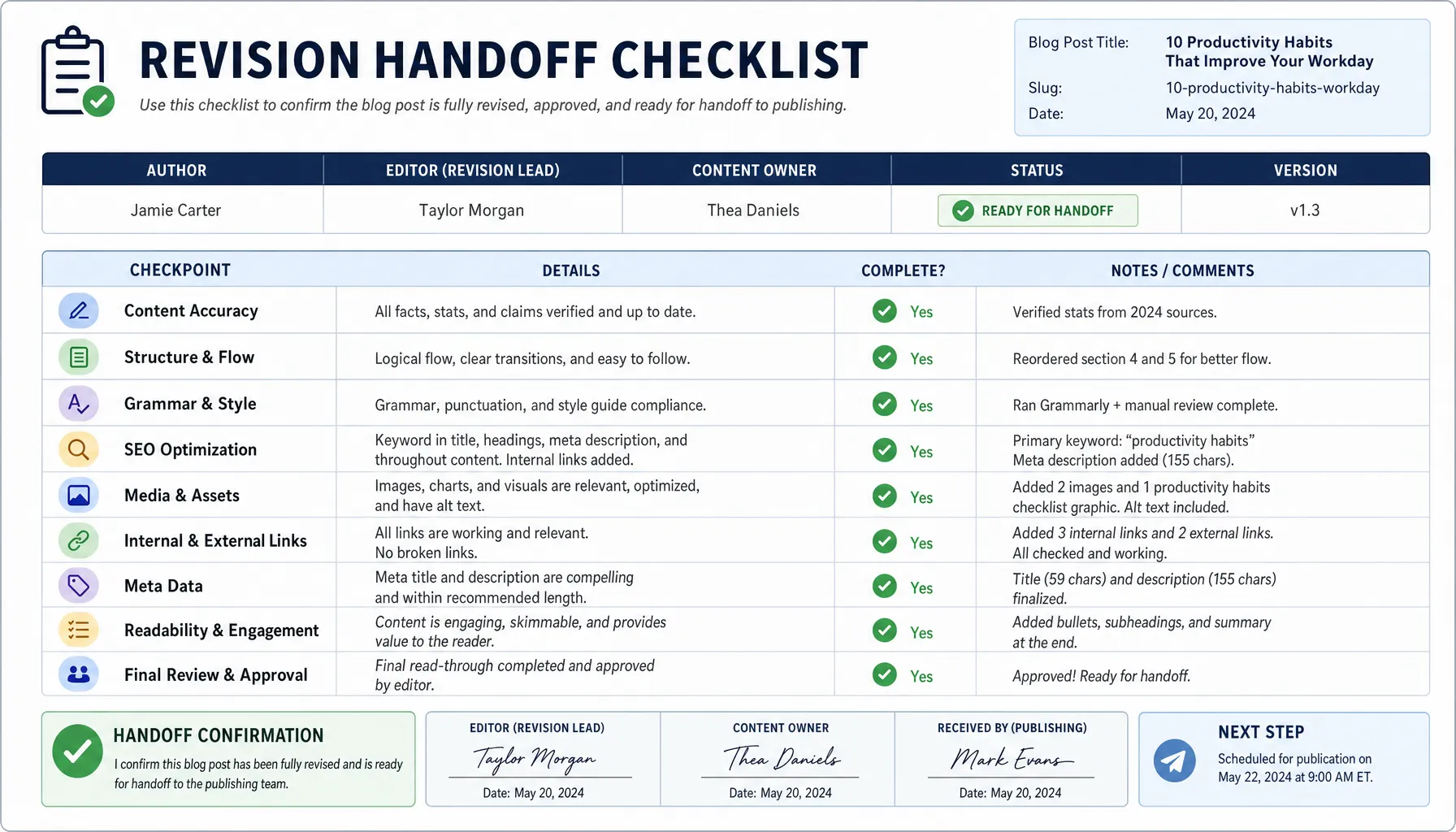
Here is an illustrative example of the revision handoff template filled in for a blog post review scenario:
--- Revision Handoff Checklist ---

Document Title: How to Boost Local SEO on a Small Budget
Version: v2.0
Owner: Jamie Patel
Date: 2026-09-01

Summary of Changes:
Expanded the 'Free Tools' section and clarified outreach strategies based on reviewer feedback. Adjusted intro for a more actionable tone.

Key Sections Changed:
- Introduction
- Free Tools for Local SEO
- Outreach Strategies

Change Log (Mapped to Previous Feedback):
- "Intro needs clearer value proposition": Rewrote intro to state outcomes more directly.
- "List more free SEO tools": Added three new tools with brief descriptions.
- "Expand outreach strategies": Provided two additional strategies and clearer step-by-step advice.

Reviewer Focus Areas:
Please review the revised intro for clarity and check if the new outreach strategies address previous concerns.

Deadline for Review: 2026-09-04
Communication Channel: Slack #content-reviews
Working the Checklist Into Your Editorial Workflow
To enhance the effectiveness of revision handoffs, integrate the checklist at clear moments in your editorial process. For most small teams, best practices include:
- Trigger points: Require the checklist when submitting any significant revision, not minor typo fixes.
- Ownership: The content creator or editor completing the revision fills out the checklist and attaches it to the revised draft.
- Central storage: Save the blank template in a shared folder or content management system so it is always accessible.
- Iterate fields: Periodically review the checklist sections as your workflow evolves to ensure relevance and clarity.
By clarifying roles, expectations, and when handoffs are needed, teams can make revision cycles faster and more predictable, fostering smoother collaboration overall.
Quick Final Checklist for Every Revision Handoff
- Confirm the document has a clear version label and date.
- Add a concise summary of changes and highlight updated sections.
- Map each major change to specific prior comments or feedback.
- Specify what the reviewer should focus on.
- Set and communicate the review deadline and channel for feedback.
Using this checklist helps keep every handoff efficient, clear, and actionable for your team.
